September, 2023
Goodman Group (GMG) ♦ 6.9% GMG represents one of the biggest holdings in the portfolio. However, given the substantial benchmark weight, the portfolio remains underweight in a relative sense. The position thereby detracted value from a relative perspective during the quarter.
GMG released its full year financial result in August. The result itself was in line with expectations. Property investments performed solidly, with net property income growing 4.7%, supported by strong rental reversions upon releasing, particularly in North America. Despite the solid performance, GMG is not immune from cap rate expansion, with the portfolio's weighted average capitalisation rate expanding from 4.0% to 4.5% over the year, with further expansion likely in coming periods. GMG's funds management performance slightly disappointed, with earnings down from 2022 as performance fees were not recognised in the second half of the financial year. Over the longer term, GMG guided to fee income of -0.9% of assets under management, below previous suggestions of -1.0%. Assets under management did grow strongly, now at $81 billion. GMG's development earnings were the driver of growth in the 2023 financial year, increasing from $960.7 million in 2022, to $1,307.2 million. A strong yield on cost for developments and completions of $6.9 billion supported this robust outcome.
GMG's share price initially had a muted reaction to the solid result, however some commentary in the earnings call and subsequent consideration by market participants led to a rally in GMG's share price. There was a focus on GMG's data centre business. The company commented that of their development work-in- progress, data centres represented 30%. This comes from rezoning existing industrial land and developing data centres. There was also commentary around the ability to establish a data centre platform, which could double the end value of developments. With much market excitement surrounding the use of data, artificial intelligence and the structural shifts that this may cause, some got excited about this nascent business. This business is still small relative to GMG's wider business and the ability to create a full operational platform is still uncertain. Economic depreciation of data centre infrastructure (as opposed to solely property) remains uncertain and could make this line of business more questionable.
Much like in the past, GMG also highlighted some of its more valuable land bank, which over time will be converted to residential usage. Property in South Sydney and North Ryde in Sydney and Port Melbourne are likely to have residential uses in the next decade. Whilst there is no doubt upside from these sites, it must be remembered that much of this property is held in partnerships, in which GMG is a minority investor and must be considered in the context of GMG's market capitalisation of more than $44 billion.
Abacus Group (ABP): Abacus Property Group (ABG) ♦ 19.8% / Abacus Storage King (ASK) ♦ 26.2% The portfolio began the quarter holding an overweight position in ABP and ended the quarter holding an overweight position in both of the restructured entities, ABG and ASK. Their underperformance detracted value from an absolute and relative perspective over the quarter.
During the September quarter, ABP split into two stocks, a newly spun off ASK and the residual entity, ABG. Initially announced at its half yearly financial result in February, ABP completed its spinoff of its storage properties into ASK in August. ASK is now the owner and operator of 131 self-storage property assets across Australia. These properties are operated under the Storage King brand, which itself is now owned by ASK. In Phoenix's view ASK owns the premier storage property portfolio in the nation, with a heavy weighting to in-demand, metropolitan locations. Under Abacus management, the self-storage portfolio has had a very strong history of industry leading occupancy and revenue per available metre (RevPAM) growth. Abacus also has a strong history of developing successful self-storage assets. Currently 36 of its 131 assets are classified as part of the "stabilising portfolio", meaning they are either development sites or recently completed developments.
Globally, the self-storage asset class is in strong demand. US heavyweight, Public Storage, recently announced it was acquiring Simply Self Storage from Blackstone for US$2.2 billion and Teachers Insurance Annuity Association of America (TIAA) announced it was acquiring Norwegian company Self Storage Group ASA for a premium of 66.7% to its prevailing share price. ASK's most direct competitor, National Storage REIT (NSR), finished the quarter trading at a relatively modest 11% discount to its net tangible asset backing. In contrast, ASK finished the period trading at an enormous 34% discount to its net tangible asset backing.
As part of the split transaction, ASK undertook a capital raise, which served to reduce gearing across the Abacus entities. The ongoing ABG entity is a beneficiary of this. With reduced leverage, ABG now owns the fund manager of ASK and its largest asset is a 19.9% stake in ASK. It also owns office properties with a carrying value of more than $1.7 billion and other property assets (mostly retail property) with a carrying value of more than $800 million. These assets suffer from the same concerns as any office property portfolio, with the requirement to pay elevated levels of incentives and a more uncertain future of the usage of office buildings. ABG closed the quarter trading at approximately a 50% discount to its net tangible asset backing, among the largest discounts in the sector. This discount exists despite ABG having significantly lower leverage than many other REITS and an investment in the more popular self-storage sector.
File: https://commentary.quantreports.net/wp-content/uploads/2020/10/2023-09-PSF-Investment-Report.pdfJune, 2023
The S&P/ASX 300 A-REIT Accumulation Index moved higher in the June quarter, rising 3.2%. Property stocks reversed recent trends and outperformed broader equities in the quarter, with the S&P/ASX 300 Accumulation Index adding a lessor 1.0%. This outperformance is relatively surprising considering the 10 Year Australian Government Bond yield increased meaningfully over the quarter, finishing at approximately 4.0%.
Many property owners released their valuations as at 30 June. Broadly speaking properties saw expansions in capitalisation rates (cap rates). For industrial property owners, strong market rent growth mostly offset this cap rate expansion, holding valuations close to flat in most cases. Retail and office properties did not hold up as well, with market rents holding relatively steady amidst cap rate expansion. Properties with long weighted average lease expiries (WALEs) and low capitalisation rates saw the biggest declines in values due to their interest rate sensitive nature.
Property fund managers were predominantly outperformers during the quarter. Smaller capitalisation fund managers performed particularly well, with Centuria Capital Group (CNI) up 13.1%, Qualitas Limited (QAL) gaining 12.6% and Elanor Investors Group (ENN) adding 9.3%. Goodman Group (GMG) was also a solid performer, lifting by 7.6%, while Charter Hall Group (CHC) gave up ground, off 0.7%, likely due to its exposure to office property.
Retail property owners were the major underperformers during the quarter. A series of more negative data points came out across the period. Firstly, retail sales figures underperformed expectations. Furthermore, many retailers who provided sales updates during the quarter disappointed investors. Fashion retailer Universal Store Holdings Limited (UNI) severely disappointed and fell almost 40% in May. Larger retailers JB Hi-Fi (JBH) and Super Retail Group (SUL) also had soft performance, declining by more than 10% from intra-period highs. This weak performance of retailers was reflected in the share prices of their landlords. Vicinity Centres (VCX) lost 5.1%, Scentre Group (SCG) gave up 3.6% and offshore property owner Unibail-Rodamco-Westfield finished 3.8% lower. The performance of less discretionary neighbourhood shopping centre owners was not as weak, however still underperformed the broader property market, with Region Group (RGN) and Charter Hall Retail REIT (CQR) off 0.1% and 0.6% respectively.
Office property owners had mixed fortunes in the June quarter. Dexus (DXS) recovered some lost ground in the period, adding 7.0%. In contrast, Centuria Office REIT (COF) lost 1.7% and Growthpoint Properties Australia (GOZ) gave up 5.0%. Direct office transactions have been extremely limited in recent periods, with buyers and sellers appearing to have divergent price expectations. Those properties that have traded have done so at discounts to book value of between 10% and 25%.
Those with exposure to residential development had a very strong period of performance. Mirvac Group (MGR) led the way, up 11.2%, while large capitalisation peer Stockland added 4.9%. Peet Limited was also an outperformer in the quarter, gaining 9.3%. Resilience in residential house prices has been surprising, with developers likely to be supported by high net immigration numbers along with limited supply of new housing.
File: https://commentary.quantreports.net/wp-content/uploads/2020/10/PSF-Investment-Report-1.pdfMarch, 2023
• Since inception, in April 2008, the Fund has delivered an annualised return, net of fees, of 7.4% compared to a 4.0% return from the S&P/ASX 300 A-REIT Accumulation Index
• The Fund delivered a net return of -1.2% over the March 2023 quarter, underperforming the 0.3% return from the S&P/ASX 300 A-REIT Accumulation Index
• Positive contributions to the Fund’s relative performance over the quarter came from an overweight position in residential developer Peet Limited along with no holdings in some of the weaker stocks such as Region Group, Ingenia Communities and Dexus
• Detracting from the Fund’s relative performance over the quarter were overweight positions in Charter Hall Group, Qualitas Limited, and Hotel Property Investments, each of which performed poorly, along with underweight positions in relatively strong performers, Goodman Group and National Storage REIT
File: https://commentary.quantreports.net/wp-content/uploads/2020/10/PSF-Investment-Report.pdfDecember, 2022
Since inception, in April 2008, the Fund has delivered an annualised return, net of fees, of 7.60% compared to a 4.01% return from the S&P/ASX 300 A-REIT Accumulation Index.
The Fund delivered a net return of -9.10% over the December 2022 quarter, underperforming the 11.56% return from the S&P/ASX 300 A-REIT Accumulation Index
The property index outperformed the broader equity market, with the S&P/ASX 300 Accumulation Index up 9.1%
Positive contributions to the Fund’s relative performance over the quarter came from overweight positions in Hotel Property Investments and Unibail-Rodamco-Westfield along with an underweight position in the underperforming Scentre Group
Detracting from the Fund’s relative performance over the quarter was an underweight position in the outperforming Dexus, combined with overweight positions in Lendlease Group, Sunland Group, Charter Hall and GDI Property Group, each of which performed poorly
File: https://commentary.quantreports.net/wp-content/uploads/2020/10/PSF_Investment-report_DEC22.pdfSeptember, 2022
Since inception, in April 2008, the Fund has delivered an annualised return, net of fees, of 7.1% compared to a 3.3% return from the S&P/ASX 300 A-REIT Accumulation Index
The Fund delivered a net return of -2.7% over the September 2022 quarter, outperforming the -6.9% return from the S&P/ASX 300 A-REIT Accumulation Index
The property index underperformed the broader equity market, which moved slightly higher in the period
Positive contributions to the Fund’s performance over the quarter came from positions in Charter Hall Group, Qualitas Limited, and Peet
Detracting from the Fund’s performance over the quarter was a holding in Transurban Group, and poor relative positioning in Scentre Group
File: https://commentary.quantreports.net/wp-content/uploads/2020/10/PSF_Investment-report_SEP22.pdfJune, 2021
• Since inception, in April 2008, the Fund has delivered an annualised return, net of fees, of 8.8% compared to 5.1% return from the S&P/ASX 300 A-REIT Accumulation Index.
• The property sector powered higher over the quarter, adding 10.7%.
• The property sector outperformed the broader market with the S&P/ASX 300 Accumulation Index also delivering a solid 8.5% gain.
• Positive contributions to the Fund’s relative performance over the quarter came from an overweight position in the outperforming APN Property Group and Charter Hall Group along with an underweight position in the underperforming Scentre Group.
• Detracting from the Fund’s relative performance over the quarter was an underweight position in Goodman Group combined with overweight positions in Lendlease Group and Sydney Airport, each of which performed poorly.
December, 2020
• Since inception, in April 2008, the Fund has delivered an annualised return, net of fees, of 8.3% compared to 4.5% return from the S&P/ASX 300 A-REIT Accumulation Index
• The property sector underperformed the broader market with the S&P/ASX 300 Accumulation Index adding 13.8%
• The property sector underperformed the broader market gaining 13.3%, with the S&P/ASX 300 Accumulation Index adding 13.8%
• Positive contributions to the Fund’s relative performance over the quarter came from an overweight position in the outperforming UnibailRodamco-Westfield, Sunland Group, and Charter Hall Group along with an underweight position in the underperforming Goodman Group
• Detracting from the Fund’s relative performance over the quarter was an underweight position in Scentre Group. Overweight positions in the underperforming APN Convenience Retail REIT and Charter Hall Long WALE REIT also detracted value
File: https://commentary.quantreports.net/wp-content/uploads/2020/10/Insight-33-FUNDS-PSF.pdfSeptember, 2020
• Since inception, in April 2008, the Fund has delivered an annualised return, net of fees, of 7.0% compared to 3.6% return from the S&P/ASX 300 A-REIT Accumulation Index
• Over the September 2020 quarter, the Fund delivered a return of 4.0%, underperforming the benchmark which returned 7.4%
• The property sector outperformed the broader market gaining 7.4%, with the S&P/ASX 300 Accumulation Index losing 0.1%
• Positive contributions to the Fund’s relative performance over the quarter came from an overweight position in the outperforming Charter Hall Group, Charter Hall Social Infrastructure REIT and Sunland Group along with an underweight position in the underperforming Vicinity Centres
• Detracting from the Fund’s relative performance over the quarter was an underweight position in Stockland combined with no holding in Goodman Group, both of which performed well. Overweight positions in the underperforming Unibail-Rodamco-Westfield ALE Property Group, Lendlease Group and APN Property Group also detracted value
June, 2020
Since inception in April 2008, the Fund has delivered an annualised return, net of fees, of 6.8% compared to 3.1% return from the S&P/ASX 300 A-REIT Accumulation Index • Over the June 2020 quarter, the Fund delivered a return of 17.2%, underperforming the benchmark which returned 20.2% • The property sector outperformed the broader Australian Market, with the S&P/ASX 300 Accumulation Index rising 16.8% • Positive contributions to the Fund’s relative performance over the quarter came from an overweight position in the outperforming Charter Hall Group, along with underweight positions in the underperforming Shopping Centres Australasia and Dexus • Detracting from the Fund’s relative performance over the quarter was an underweight position in Stockland combined with no holding in Goodman Group, both of which performed well. Overweight positions in the underperforming Unibail-Rodamco-Westfield and APN Property Group also detracted value
File: https://commentary.quantreports.net/wp-content/uploads/2020/10/PSF-Latest-Investment-Report.pdfticker: CRM0008AU
commentary_block: Array
factsheet_url:
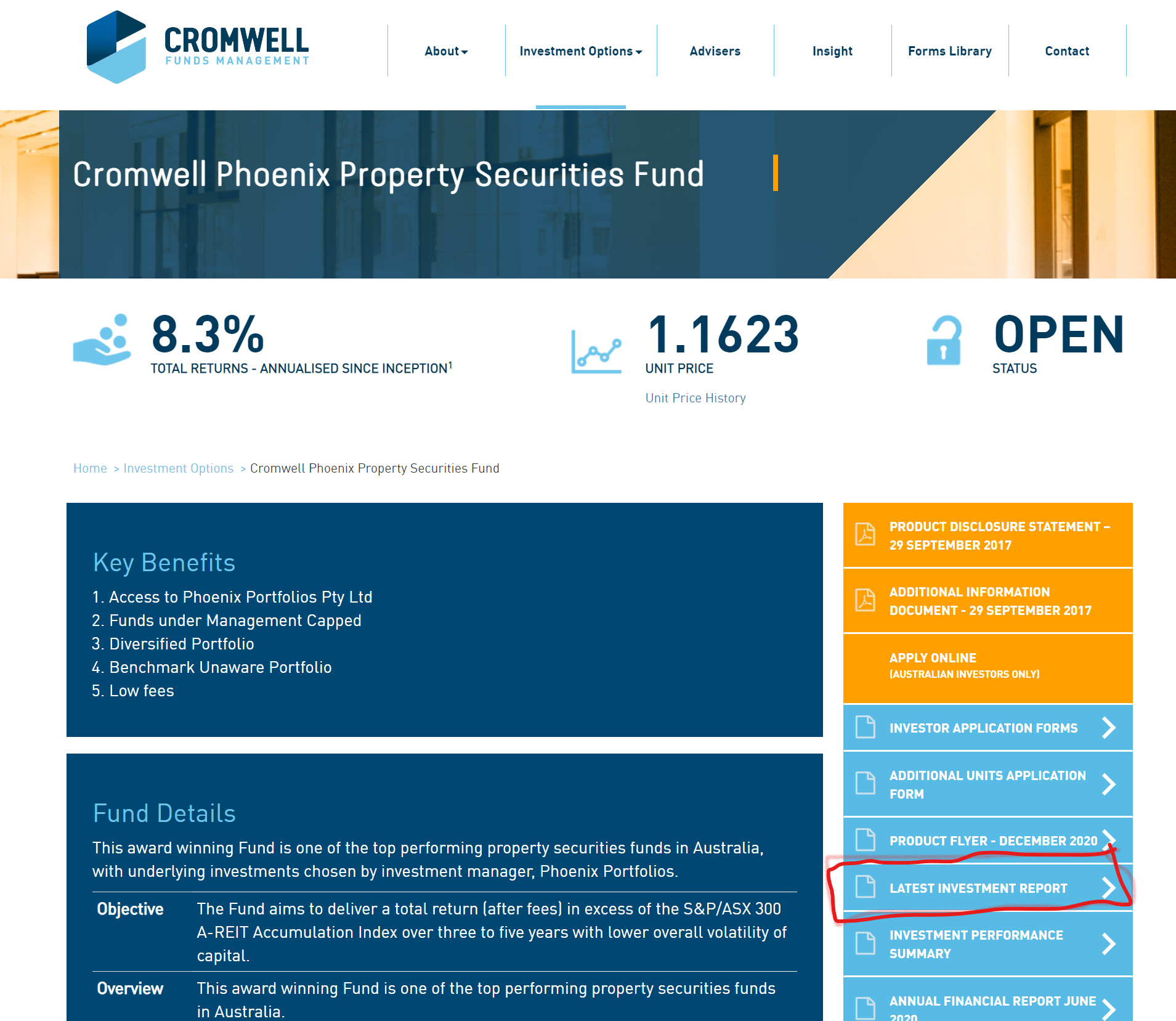
https://www.cromwell.com.au/investment-options/cromwell-phoenix-securities-fund
Right sidebar -> LATEST INVESTMENT REPORT
release_schedule: Quarterly
fund_features:
Cromwell Phoenix Property Securities Fund’s objective is to provide investors with a total return (after fees) in excess of the S&P/ASX 300 A-REIT Accumulation Index over rolling three year periods while delivering lower total risk (as measured by the volatility of returns) over this period.
- Value investing style.
- The manager to be more of a core style and believes the Fund has the ability to outperform in both up and down markets.
- The strategy permits holdings in infrastructure securities, property developers, fund managers, traditional REITS, and hybrids.
- The team demonstrated the skill in identifying good opportunities down the market-cap ladder.
manager_contact_details: Array
asset_class: Property and Infrastructure
asset_category: Australian Listed Property
peer_benchmark: Property - Australian Listed Property Index
broad_market_index: ASX Index 200 A-REIT Index
structure: Managed Fund