October, 2023
Realindex Emerging Markets Value returned -2.40% (net of fees) during October, versus the MSCI Emerging Markets Net Index which returned -2.03% (in AUD).
October was a challenging month for financial markets, with bonds and stocks falling simultaneously due to rising bond yields and heightened geopolitical uncertainty, ultimately weighing on market sentiment. Commodities were the notable outperformer, as energy prices rallied and investors fled to safe assets such as gold. The collapse in the bond market continued in October with US treasury yields rising above 5% driven by a ‘higher for longer’ scenario with rates. This in turn affected equity markets with the implication on higher rates on earnings multiples and a reduction in risk appetite stemming from the Israel-Hamas conflict.
Amidst this backdrop, Emerging Markets lagged their Developed Market peers by more than 1% in AUD terms. The biggest driver of downward pressure came from China, where despite positive retail sales and industrial production numbers were present, weakness in the Real Estate sector continued to weigh down the Chinese equity market, with MSCI China falling by more than 4% in local terms during October. Real Estate (MSCI EM Real Estate) names fell the most posting - 6.2% in AUD terms, along with Industrials (MSCI EM Industrials -6.7%), while Health Care (MSCI EM Health Care: +2.6%) offered some positive returns. Value stocks were only slightly weaker, underperforming Growth stocks by 0.1% over the month (MSCI Emerging Markets Value -2.1% vs. Growth -2.0%, in AUD). Over the past year, Value has outperformed Growth by 5.2% (AUD), while on a five year basis Value has underperformed Growth by 0.9% p.a. (AUD), providing a longerterm performance headwind.
Within this context, given its value orientation, the fund also underperformed the market in October, largely driven by the underweights to Health Care and Technology names and the overweight to Real Estate. Positive stock selection in Communication Services which the fund was underweight, provided some positive performance. On a country basis, one of the largest contributors to performance was the overweight to South Africa and some of the largest detractors were the underweight to Taiwan and overweight to China. The fund was also adversely impacted by the overweight to Turkey which performed poorly during the month. From a sector perspective, a large contributor was the underweight to Communication Services and a large detractor was the underweight to Information Technology. One of the largest stock level contributors was the overweight to Lenovo Group Limited and one of the largest stock level detractors was the underweight to Taiwan Semiconductor Manufacturing Company Limited.
Driven by the methodology of rebalancing further into cheap value companies, the portfolio continues to sit on deep valuation discounts. At the end of October 2023 the portfolio reflected a 77.7% dividend yield premium to the MSCI EM index, whilst trading at a 34.8% price to book discount, a 49.7% price to cashflow discount and 49.0% price to sales discount, indicating that the portfolio remains well positioned for mean reversion in Value.
Note: Returns in parenthesis show the total return for the month ending 31 October 2023. All returns are given in local currency terms unless otherwise stated.
File: https://commentary.quantreports.net/wp-content/uploads/2021/01/Realindex-Emerging-Markets-Value-Class-A-Adviser-Flyer-7.pdfAugust, 2023
Realindex Emerging Markets Value returned -2.75% (net of fees) during August, versus the MSCI Emerging Markets Net Index which returned -2.36% (in AUD).
Emerging Markets performed poorly with the MSCI EM index posting -2.36% (AUD terms). This mainly stemmed from the downtown in economic indicators in China and its debt levels, which are creating challenges within the Property Sector. Poor performance was also seen in Asian markets with the Hong Kong’s Hang Seng and China’s CSI 300 falling by 8.5% and 6.2%, respectively. Overall within the MSCI EM Index, 10 out of 11 sectors were negative with the worst performers being Consumer Discretionary (-4.2%), Communication Services (-4.2%), and Utilities (-3.7%).
Within this environment, Value stocks in Emerging Markets outperformed Growth stocks by 0.5% over the month (MSCI Emerging Markets Value -2.1% vs. Growth -2.6%, in AUD). Over the past year Value has outperformed Growth by 8.0% (AUD), while on a five year basis Value has underperformed Growth by 0.05% p.a. (AUD).
Despite this, fund performance was lower than the benchmark over the month, mainly due to stock selection within Sectors and poor positioning across countries. From a sector perspective, positive stock selection in Energy names were more than offset by stock selection in Financials, Materials and Information Technology, which were the main detractors to performance. From a sector positioning perspective, the overweight to Financials aided the fund, while the underweight to Information Technology was a detractor. On a country basis, allocation effects hindered performance especially the underweight to India. The overweight to Korea was the largest contributor to performance stemming mainly from strong stock selection, while the overweight to China was the largest detractor as a result of stock selection, particularly from Chinese Communication Services and Real Estate names. The largest stock level contributor was the overweight to REC Limited and the largest stock level detractor was the overweight to Ping An Insurance (Group) Company of China, Ltd.
Driven by the methodology of rebalancing further into cheap value companies, the portfolio continues to sit on deep valuation discounts. At the end of August 2023 the portfolio reflected a 78.6% dividend yield premium to the MSCI EM index, whilst trading at a 33.8% price to book discount, a 49.5% price to cashflow discount and 50.3% price to sales discount, indicating that the portfolio remains well positioned for mean reversion in Value.
Note: Returns in parenthesis show the total return for the month ending 31 August 2023. All returns are given in local currency terms unless otherwise stated.
File: https://commentary.quantreports.net/wp-content/uploads/2021/01/Realindex-Emerging-Markets-Value-Class-A-Adviser-Flyer-6.pdfJuly, 2023
Realindex Emerging Markets Value returned +5.58% (net of fees) during July, outperforming the MSCI Emerging Markets Net Index which returned +4.93% (in AUD).
Global stocks performed well in July, with most regional markets posting positive gains. Abating inflation in the US and abroad, and increasing evidence pointing to a soft landing has helped support global equities. US headline inflation fell more than expected to 3% year on year. In response, the S&P 500 index rose 3.2% in USD terms in July, taking year to date returns to over 20%. This was despite the US Federal Reserve raising rates by 25 basis points in line with market expectations. In China, despite a slowing in GDP growth for the second quarter, the MSCI China Index posted a solid 9.1% in local currency and pushed Asian equities higher in July - largely a response to policy easing and hopes for further stimulus within the Chinese economy. Within Emerging Markets, performance was strong with China leading major markets. Consumer Discretionary (+12.5%), Materials (+7.7%) and Real Estate (+6.4%) sectors led MSCI Emerging Markets in July, while Information Technology names lagged (-0.35%).
Within this environment, Value stocks outperformed Growth stocks by 0.6% over the month (MSCI Emerging Markets Value +5.2% vs. Growth +4.7%, in AUD). Over the past year, Value has outperformed Growth by 7.1% (AUD), while on a five year basis, Value has outperformed Growth by 0.1% p.a. (AUD).
From a sector perspective, the fund strongly benefited from stock selection within Information Technology and its underweight to the sector, largely the result of its underweight to Semiconductors. Stock selection within Materials was also a positive contributor to performance. On the other hand, the fund was negatively impacted by its underweight to the Consumer Discretionary sector as well as poor stock selection within that sector. Regionally, the fund benefited from underweights to Taiwan and India, while stock selection in China was a major detractor, largely stemming from its underweights to Chinese Consumer Discretionary names. The largest stock level contributor was the overweight to Wistron Corporation and the largest stock level detractor was the underweight to Alibaba Group Holding Limited.
Driven by the methodology of rebalancing further into cheap value companies, the portfolio continues to sit on deep valuation discounts. At the end of July 2023 the portfolio reflected a 80.0% dividend yield premium to the MSCI EM index, whilst trading at a 29.3% price to book discount, a 50.6% price to cashflow discount and 49.9% price to sales discount, indicating that the portfolio remains well positioned for mean reversion in Value.
File: https://commentary.quantreports.net/wp-content/uploads/2021/01/Realindex-Emerging-Markets-Value-Class-A-Adviser-Flyer-5.pdfMay, 2023
Realindex Emerging Markets Value returned -0.46% (net of fees) during May, versus the MSCI Emerging Markets Net Index which returned +0.40% (in AUD). Emerging Markets were down in May, with Chinese equities underperforming (MSCI China -6.5%) following weaker than expected economic data.
Expectations of China’s growth recovery receded as various economic data points missed expectations and further policy measures to steady growth remained absent. The official manufacturing PMI fell to a below-forecast 48.8 in May, marking the second consecutive contraction for the year. Korean (MSCI Korea + 7.0%) and Taiwanese (MSCI Taiwan +9.6%) stocks outperformed, largely driven by the Information Technology sector amid growing expectations of the future potential of AI. Latin America was positive but muted for May (MSCI Latin America: +1.3%).
Within this environment, the strategy underperformed given the relative strength of growth based names during the month; Value stocks underperformed Growth stocks by 0.4% over the month (MSCI Emerging Markets Value +0.2% vs. Growth +0.6%, in AUD). Over the past year, Value has outperformed Growth by 4.8% (AUD), while on a five-year basis Value has outperformed Growth by 0.2% p.a. (AUD).
From a sector perspective, while favourable under-weight positioning in Consumer Discretionary names boosted performance, the fund’s overweight positioning to Financials and, in particular, Insurers was the main detractor to performance. The underweight to Information Technology names, in particular within Semiconductor manufacturers who benefited from renewed investor interest in AI related stocks, was another key detractor. On a country basis, the largest detractor was the underweight to India and Taiwan, while the largest contributor was the overweight to China, though much of this was due to the funds underweight to Chinese Consumer Discretionary names. The largest stock level detractor was the underweight to Taiwan Semiconductor Manufacturing Company Limited and the largest stock level contributor was the overweight to Wistron Corporation.
Driven by the methodology of rebalancing further into cheap value companies, the portfolio continues to sit on deep valuation discounts. At the end of May 2023 the portfolio reflected a 75.9% dividend yield premium to the MSCI EM index, whilst trading at a 33.3% price to book discount, a 52.2% price to cashflow discount and 50.9% price to sales discount, indicating that the portfolio remains well positioned for mean reversion in Value.
File: https://commentary.quantreports.net/wp-content/uploads/2021/01/Realindex-Emerging-Markets-Value-Class-A-Adviser-Flyer-4.pdfApril, 2023
Realindex Emerging Markets Value returned +2.61% (net of fees) during April, outperforming the MSCI Emerging Markets Net Index which returned +0.20% (in AUD).
Global equity markets were mixed amidst persistent inflation which continued to pose a challenge to central banks. US stocks made limited gains in April led by large caps, as investor optimism resulting from the Fed’s anticipated moderation of monetary policy was tempered by concerns over economic growth.
Uncertainty in the banking sector also continued with the collapse of First Republic bank. China reaffirmed its supportive policy stance for the economy amidst growing exports and consumer demand. Despite this, China’s equity market continued to underperform in April, leading emerging markets lower as concerns over its political stance on Taiwan, relationship with Russia and ongoing regulations with the private sector still weigh on investors.
Overall, Emerging equity markets were very weak in April, lagging developed markets with the MSCI EM Index posting +0.2% in AUD terms. Value oriented sectors Energy (+7.6%) and Financials (+5.6%) strongly outperformed growth oriented Consumer Discretionary and Communication Services sectors with each posting -5.7% and -4.3% respectively.
In this environment, the portfolio benefitted from its exposure to Value stocks which outperformed Growth stocks by 3.0% over the month (MSCI Emerging Markets Value +1.8% vs. Growth -1.3%, in AUD). Over the past year Value has outperformed Growth by 5.9% (AUD), while on a five year basis Value has outperformed Growth by 0.3% p.a. (AUD).
The portfolio strongly benefitted from its overweight positioning in China; in particular its large overweight to China Financials and underweight to China Consumer Discretionary names were the biggest drivers of the portfolio from a country perspective. The portfolio’s underweight to India and Saudi Arabia were amongst the largest detractors to performance from a country perspective. From a sector perspective, favourable positioning in Financials which the portfolio is significantly overweight helped drive performance, along with the portfolio’s underweight to IT names. The largest detractor from a sector perspective was the overweight to Materials, largely the result of stock selection. The largest stock level contributor was the underweight to Tencent Holdings Ltd. and the largest stock level detractor was the underweight to Reliance Industries Limited.
Driven by the methodology of rebalancing further into cheap value companies, the portfolio continues to sit on deep valuation discounts. At the end of April 2023 the portfolio reflected a 75.7% dividend yield premium to the MSCI EM index, whilst trading at a 33.3% price to book discount, a 53.5% price to cashflow discount and 51.5% price to sales discount, indicating that the portfolio remains well positioned for mean reversion in Value.
Note: Returns in parenthesis show the total return for the month ending 30 April 2023. All returns are given in local currency terms unless otherwise stated.
File: https://commentary.quantreports.net/wp-content/uploads/2021/01/Realindex-Emerging-Markets-Value-Class-A-Adviser-Flyer-3.pdfFebruary, 2023
Realindex Emerging Markets Value returned -1.49% (net of fees) during February, outperforming the MSCI Emerging Markets Net Index which returned - 2.28% (in AUD).
Emerging markets were mixed in February, with China (-6.4%) and Brazil (-5.1%) trading lower and Turkiye (+10.5%) and Eastern Europe trading higher. A warmer European winter along with their ability to diversify energy imports have meant a fully-fledged energy crisis has not materialized. This, along with China’s reopening, has brought a degree of softening or cautious optimism in the global economy. Beijing has begun to support housing demand and restore consumer sentiment, after limiting leverage last year in the wake of the liquidity crisis. Turkiye’s central bank has lowered rates to support the economy in the aftermath of the earthquake. In the MSCI Emerging Markets Index, majority of sectors fell for the month with Consumer Discretionary (-8.6%) and Utilities (- 7.2%) struggling the most, while Consumer Staples (+0.7%) and Information Technology (+0.7%) posted the only positive returns.
Within this environment, Value stocks outperformed Growth stocks by 2.2% over the month (MSCI Emerging Markets Value -1.1% vs. Growth -3.4%, in AUD). Over the past year Value has outperformed Growth by 5.7% (AUD), while on a five year basis Growth has outperformed Value by 0.2% p.a. (AUD).
The fund outperformed the benchmark due to strong stock selection within China (+137bps) while the largest detractor was the overweight to Hong Kong. The biggest wins for the fund were the underweights to Chinese Consumer Discretionary and Information Technology names such as Meituan (+22bps) and Alibaba (+18bps). Overall, the largest detractors were stock selection in Financials such as the overweight to Ping An Insurance (Group) Company of China, Ltd.
Driven by the methodology of rebalancing further into cheap value companies, the portfolio continues to sit on deep valuation discounts. At the end of February 2023 the portfolio reflected a 81.0% dividend yield premium to the MSCI EM index, whilst trading at a 36.1% price to book discount, a 50.3% price to cashflow discount and 52.5% price to sales discount, indicating that the portfolio remains well positioned for mean reversion in Value.
Note: Returns in parenthesis show the total return for the month ending 28 February 2023. All returns are given in local currency terms unless otherwise stated.
File: https://commentary.quantreports.net/wp-content/uploads/2021/01/Realindex-Emerging-Markets-Value-Class-A-Adviser-Flyer-2.pdfJanuary, 2023
Realindex Emerging Markets Value returned +4.00% (net of fees) during January, outperforming the MSCI Emerging Markets Net Index which returned +3.84% (in AUD).
Global markets were off to a solid start in January as falling inflation, relatively robust economic data, and China’s COVID policy change drove investor hopes of a “soft landing” for the global economy. Equities, bonds and alternatives generally rose on the back of this renewed optimism while bond yields declined and equity market volatility fell to its lowest level in almost a year. In Emerging Markets, the positive gains observed were in part driven by China; improved economic momentum and confidence was reflected by the outperformance of the Chinese market, both onshore (CSI 300 Index +7.3%) and offshore (Hang Seng Index +10.4%). Growth oriented sectors outperformed with Information Technology (+9.4%) as well as Communication Services and Discretionary sectors leading the way. Utilities (-6.7%) and Energy (-1.5%) were the main underperforming sectors.
Within this risk on market environment, Value stocks underperformed Growth stocks by 1.3% over the month (MSCI Emerging Markets Value +3.2% vs. Growth +4.5%, in AUD). Over the past year Value has outperformed Growth by 5.8% (AUD), while on a five year basis Value has underperformed Growth by 0.7% p.a. (AUD).
Despite Growth’s strength during the month, the fund managed to outperform owing to good positioning to India, which the fund was underweight; in particular within Indian Financials. Poor stock selection in Chinese names which the fund was overweight was the main detractor in performance from a country perspective, though this was not enough to offset the overall gains observed from the fund’s other country positions. From a sector allocation perspective, whilst the overweight to Financials was a detractor, stock selection within Financials and predominantly banks more than offset those poor allocation effects. This made Financials the most significant contributor to performance from a sector perspective. The underweight to Information Technology names also detracted performance, however stock selection was the most significant detractor from a sector perspective. The largest stock level contributor was the overweight to Ping An Insurance (Group) Company of China, Ltd. and the largest stock level detractor was the underweight to Taiwan Semiconductor Manufacturing Co., Ltd.
Driven by the methodology of rebalancing further into cheap value companies, the portfolio continues to sit on deep valuation discounts. At the end of January 2023 the portfolio reflected a 80.8% dividend yield premium to the MSCI EM index, whilst trading at a 40.1% price to book discount, a 52.3% price to cashflow discount and 55.2% price to sales discount, indicating that the portfolio remains well positioned for mean reversion in Value.
File: https://commentary.quantreports.net/wp-content/uploads/2021/01/Realindex-Emerging-Markets-Value-Class-A-Adviser-Flyer-1.pdfDecember, 2022
Realindex Emerging Markets Value returned +7.30% (net of fees) during the December quarter, outperforming the MSCI Emerging Markets Net Index which returned +4.01% (in AUD).
Emerging markets faced several challenges in 2022, including Russia's invasion of Ukraine, tighter financial conditions to address higher inflation, a stronger US dollar, and China's economic decline due to its zero-COVID policy and problems in the property sector. Despite a nearly 15% decline in the MSCI EM Index over the year, the asset class showed signs of recovery in Q4, due to China's focus on reopening and support for the property sector, as well as signs that inflation may have peaked across several emerging economies. In Q4, many emerging markets delivered positive returns, with Asian and EMEA markets leading the way while LATAM performance was flat; a result of uncertainty in Brazil in the lead up to its presidential elections.
In terms of sectors, positive performance in MSCI Emerging Markets was driven by Communication Services (+7.9%) followed by Health Care (+7.3%), while Energy (-1.2%) and Utilities (-0.9%) lagged behind the index. With this backdrop, the fund benefitted from Value stocks generally outperforming Growth stocks by 0.1% over the quarter (MSCI Emerging Markets Value +4.1% vs. Growth +4.0%, in AUD). Over the past year, Value has outperformed Growth by 8.7% (AUD), while on a five year basis Value has outperformed Growth by 0.3% p.a. (AUD) which has provided further tailwinds for the fund.
From a country perspective, the fund strongly benefitted from its underweight to India, with both allocation and stock selection delivering performance. The overweight to Turkey and Korean Financials also significantly added to performance. The fund’s overweight to South Africa and Brazil were small detractors.
From a sector perspective, stock selection within Financials, the fund’s largest sector overweight, was the most significant contributor to performance. Whilst the underweight to Communication Services was the largest sector detractor, however small in comparison. The largest stock level contributor was the overweight to Ping An Insurance (Group) Company of China, Ltd. and the largest stock level detractor was the underweight to Tencent Holdings Ltd.
Driven by the methodology of rebalancing further into cheap value companies, the portfolio continues to sit on deep valuation discounts. At the end of December 2022 the portfolio reflected a 80.5% dividend yield premium to the MSCI EM index, whilst trading at a 39.7% price to book discount, a 53.1% price to cashflow discount and 56.7% price to sales discount, indicating that the portfolio remains well positioned for mean reversion in Value.
File: https://commentary.quantreports.net/wp-content/uploads/2021/01/Realindex-Emerging-Markets-Value-Class-A-Adviser-Quarterly.pdfNovember, 2022
Realindex Emerging Markets Value returned +10.47% (net of fees) during November, outperforming the MSCI Emerging Markets Net Index which returned +9.64% (in AUD).
With signs that global inflation may be easing in November, global equity markets were boosted by speculation that interest rates in key regions may not need to be raised significantly. The MSCI World Index rose 5.7%, although the gain was lower in AUD terms due to the strength of the Australian dollar. In the United States and Europe, major indices such as the S&P 500 (+5.4%), NASDAQ (+4.4%) and Euro Stoxx 50 (+9.6%) registered solid gains. However, Asian markets took the lead with strong returns from the CSI 300 (+9.8%) and Hang Seng (+26.6%) due to optimism around potential relaxation of China’s COVID restrictions. Latin America underperformed for the month (MSCI Latin America: -4.1%). off the back of weakening oil prices. The strength in Emerging Markets was most seen in Real Estate (+29.6%) and Consumer Discretionary (+20.1%) while the weakest sector was Utilities (+2.3%); overall, growth sectors such as Technology (+12.8%) in Emerging Markets outperformed.
As a result, Value stocks underperformed Growth stocks by 2.6% over the month (MSCI Emerging Markets Value +8.3% vs. Growth +10.9%, in AUD) which in turn impacted the fund’s performance. Over the past year Value has outperformed Growth by 11.8% (AUD), while on a five year basis Value and Growth have been on par.
On a country basis, the fund benefitted from the underweight to Saudi Arabia and the largest detractor was the underweight to Taiwan. From a sector perspective, the largest contributor was the overweight to Financials largely due to stock selection rather than sector positioning and the largest detractor was the underweight to Communication Services, which again was due to stock selection effects. The largest stock level contributor was the overweight to Ping An Insurance (Group) Company of China, Ltd. and the largest stock level detractor was the underweight to Tencent Holdings Ltd.
Driven by the methodology of rebalancing further into cheap value companies, the portfolio continues to sit on deep valuation discounts. At the end of November 2022 the portfolio reflected a 79.8% dividend yield premium to the MSCI EM index, whilst trading at a 37.3% price to book discount, a 51.7% price to cashflow discount and 56.3% price to sales discount, indicating that the portfolio remains well positioned for mean reversion in Value.
File: https://commentary.quantreports.net/wp-content/uploads/2021/01/Realindex-Emerging-Markets-Value-Class-A-Adviser-Flyer.pdfOctober, 2022
The Realindex Emerging Markets Fund returned -0.79% (net of fees) during October, outperforming the MSCI Emerging Markets Net Index which returned - 2.57% (in AUD).
Global markets recovered in October, posting broad gains on the hopes of more dovish central bank behaviour with some economic data pointing to softening in wage pressures and core inflation (CPI year-over-year at 8.2%, PPI at 8.5%). The gains in Developed markets which saw the MSCI World index posting +7.8% in AUD terms, were not observed in Emerging markets with the MSCI EM index falling 2.6% for the month in AUD terms. The losses were largely observed in China (MSCI China: -16%) rather than Asia more broadly, while Latin America performed strongly (MSCI Latin America: +10.3%).
Value stocks outperformed Growth stocks by 2.6% over the month (MSCI Emerging Markets Value -1.2% vs. Growth -3.8%, in AUD) helping to drive the fund’s outperformance for the month. Over the past year Value has outperformed Growth by 12.8% (AUD), while on a five year basis Value has outperformed Growth by 0.1% p.a. (AUD).
On a country basis, the largest contributor was by far the overweight to China and was the main driver of the fund’s outperformance due to stock selection.
The largest detractor was the inclusion of Hong Kong listed Chinese firms followed by the underweight to Saudi Arabia. From a sector perspective, the largest contributor was the underweight to Chinese technology adjacent firms in Consumer Discretionary and the largest detractor was the overweight to Real Estate. The largest stock level contributor was the underweight to Tencent Holdings Ltd. and the largest stock level detractor was the overweight to Ping An Insurance (Group) Company of China, Ltd.
Driven by the methodology of rebalancing further into cheap value companies, the portfolio continues to sit on deep valuation discounts. At the end of October 2022 the portfolio reflected a 81.9% dividend yield premium to the MSCI EM index, whilst trading at a 35.6% price to book discount, a 52.6% price to cashflow discount and 56.2% price to sales discount, indicating that the portfolio remains well positioned for mean reversion in Value. Note: Returns in parenthesis show the total return for the month ending 31 October 2022. All returns are given in local currency terms unless otherwise stated.
File: https://commentary.quantreports.net/wp-content/uploads/2021/01/Realindex-Emerging-Markets-Fund-Class-A-Adviser-Flyer-12.pdfSeptember, 2022
The Realindex Emerging Markets Fund returned -6.14% (net of fees) during the September quarter, versus the MSCI Emerging Markets Net Index which returned -5.42% (in AUD).
Value stocks outperformed Growth stocks by 1.3% over the quarter (MSCI Emerging Markets Value -4.8% vs. Growth -6.0%, in AUD). Over the past year, Value has outperformed Growth by 9.5% (MSCI Emerging Markets Value -14.2% vs. Growth -23.7%, in AUD). On a five year basis, Value lags Growth by 0.5% p.a. (AUD) providing a significant longer-term performance headwind.
Central banks around the world continued to signal their commitment to tighter monetary policy by combatting inflation with further rate rises. The European Central Bank indicated rates will likely be raised over several meetings following its 75bps rise in September, with further policy tightening in the US also expected following its own series of increases. In the US, the core PCE price index rose 0.6% month-over-month in August after being flat in July. In the Eurozone, preliminary data showed headline consumer price inflation reached 10% in September, an increase from 9.1% in August. Concerns over the UK's fiscal policy stance also added further volatility to markets in September, which led to the Pound/Dollar exchange rate collapsing to an all-time low, with the 30-year yield on gilts rising above 5% for the first time since 2008. It was not long before the Bank of England intervened and bought gilts, restoring market order. Geopolitical risks also remained, with the recent declaration of the annexation of four Ukrainian provinces only adding to the escalation in tensions and overall market volatility and downside risks for economic growth. The stronger US dollar, higher inflation, and tighter financial conditions also weighed on Emerging Markets equities, and relations between the United States and China came under greater strain as both countries tried to secure their supply chains and worries over Taiwan intensified
File: https://commentary.quantreports.net/wp-content/uploads/2021/01/Realindex-Emerging-Markets-Fund-Class-A-Adviser-Quarterly-2.pdfJuly, 2022
The Realindex Emerging Markets Fund returned -3.10% (net of fees) during July, versus the MSCI Emerging Markets Net Index, which returned -1.70% (in AUD).
Value stocks underperformed Growth stocks by 1.3% over the month (MSCI Emerging Markets Value -2.4% vs. Growth -1.1%, in AUD). Over the past year, Value has outperformed Growth by 9.6% (MSCI Emerging Markets Value -10.8% vs. Growth -20.4%, in AUD). On a five year basis, Value lags Growth by 1.7% p.a. (AUD) providing a significant longer-term performance headwind.
Global equities saw a recovery in July following their protracted slide during the first half of the year despite deteriorating fundamentals posed by persistent inflation and growth fears. The tech heavy Nasdaq, which saw significant losses since the start of the year, recovered by almost a third as the market began buying back beaten up stocks in a tech led rally. Despite persistent recent inflation data prints, markets priced in a more front-loaded rate hiking cycle by the Federal Reserve and other central banks, as long dated treasury yields fell. In July, US inflation expectations fell from the previous months while US core CPI also declined for three consecutive months amid concerns of a global recession. In the US, second-quarter GDP contracted 0.9% on an annualized basis, the second consecutive quarterly decline while the PMI dropped to 47.5 in July from 52.3 in June.
In response, emerging markets experienced a poorer month (MSCI EM Index), underperforming developed markets (MSCI World Index) and finishing down approximately 1.7% in AUD terms. The fall was largely the result of the Chinese market wiping away the gains seen during the previous month as economic growth fears resurfaced. MSCI China posted a loss of 10.8% in AUD terms pulling the overall emerging market index down; this was despite positive performance posted in Korea (+4.3%) and LATAM (+2.7%) while Emerging European equity markets were flat. From a sector perspective, Real Estate (-12.9%) and Consumer Discretionary (-8.8%) sectors were heavily down due to ongoing Chinese property and overall economic concerns, while IT (+2.8%) Utilities (1.9%) and Energy (1.4%) were the leading sectors in July.
File: https://commentary.quantreports.net/wp-content/uploads/2021/01/Realindex-Emerging-Markets-Fund-Class-A-Adviser-Flyer-11.pdfJune, 2022
The Realindex Emerging Markets Fund returned -3.49% (net of fees) during the June quarter, versus the MSCI Emerging Markets Net Index which returned - 3.30% (in AUD).
Value stocks outperformed Growth stocks by 1.3% over the quarter (MSCI Emerging Markets Value -2.6% vs. Growth -3.9%, in AUD). Over the past year, Value has outperformed Growth by 13.7% (MSCI Emerging Markets Value -11.1% vs. Growth -24.9%, in AUD). On a five year basis, Value lags Growth by 1.7% p.a. (AUD) providing a significant longer-term performance headwind.
Global equities resumed their protracted slide in the June quarter, with most markets significantly down in June, amid resurgent worries over the pace of global central bank tightening and concerns that elevated inflation will erode consumer confidence and lead to a global economic slowdown. By the end of June, the decline left the S&P 500 20% lower year-to-date, resulting in the worst first-half since 1970. The MSCI All Country World index also fell 2.2% in USD terms in the final week of June, leaving it down 20.9% for the first half of 2022.
A stronger US dollar coinciding with the Federal Reserve initiating a wave of quantitative tightening that has seen the most aggressive rate hikes since 1994, and the uncertainty around China’s zero-COVID policy versus those policies supporting economic growth also weighed heavily on emerging markets. Lockdown disruptions in China have led to a deeper-than-expected economic contraction, with industrial output and consumer activity reaching their lowest levels since the pandemic.
Emerging markets (EM) equities (MSCI EM Index) outperformed developed markets (MSCI World Index) in the June quarter, finishing down approximately 3.3% in AUD terms compared to down -8.5%, respectively. This marked a nearly 13% decline for the first half of 2022 for EM versus an almost 16% decline for the developed world. From a sector perspective, Information Technology (-13.5%) and Materials (-13.2%) led EM markets lower, while Latin America (- 14.7%) along with Korea (-13.6%) and Taiwan (-12.4%) negatively impacted EM equity returns from a country perspective. Much of this negative move was observed in June, where the Latin American markets were down were down almost 13.5% for the month as Energy (-4.5%) and Materials (-9%) sectors weakened following a sharp sell-off in line with energy prices retracing the gains made in the first half of the year. The Chinese equity market however recovered during the quarter from its mid-March lows buoyed by positive earning upgrades and the indication of government willingness to boost GPD with greater infrastructure. The MSCI China Index increased approximately 13% for the quarter, with most of that coming from strong performance in June.
File: https://commentary.quantreports.net/wp-content/uploads/2021/01/Realindex-Emerging-Markets-Fund-Class-A-Adviser-Flyer-10.pdfMay, 2022
The Realindex Emerging Markets Fund returned +0.36% (net of fees) during May, outperforming the MSCI Emerging Markets Net Index which returned - 0.50% (in AUD).
Value stocks outperformed Growth stocks by 0.8% over the month (MSCI Emerging Markets Value -0.1% vs. Growth -0.9%, in AUD). Over the past year, Value has outperformed Growth by 12.7% (MSCI Emerging Markets Value -6.8% vs. Growth -19.5%, in AUD). On a five year basis, Value lags Growth by 2.2% p.a. (AUD) providing a significant longer-term performance headwind.
Overall, global markets remained mixed in May. While there were pockets of positive returns in the energy and financial sectors, as well as value, the broad market fell slightly. On macro perspectives, inflation remained forefront among investors and the central banks alike. Key thematics continue to be the rate hike trajectory given persistent inflationary pressures and supply chain disruptions from the war in Ukraine. Whilst we are seeing some easing in Chinese lockdowns, China's overall zero Covid policy has remained in place. China’s growth concerns remain for the global economy as the world's second largest economy is expected to yield between 3.0 to 3.7% GDP growth for 2022, lower than the official 5.0% target. These issues paint a 'risk-off' environment globally. The US labour market continues to show strength with the unemployment rate steady at 3.6%. Wage growth and strong hiring coupled with the continued rally in commodity prices will force the US Federal Reserve to continue tightening at an aggressive pace.
Emerging markets fell slightly posting -0.5% in AUD terms. In Asia, Chinese stocks traded flat in May with Covid restrictions and geopolitical tensions largely priced in. Inflation and a looming food crisis driven in part by the war in Ukraine continue to provide strong headwinds in non LATAM EM. Hungary, Turkey and India have fallen -14.5%, -7.5% and -8.9% respectively. IT (+2.2%) and Energy (+1.6%) performed relatively well whilst REITs (-4.6%) fell sharply. On a country basis, the largest contributor was the overweight to Brazil and the largest detractor was the underweight to Taiwan. From a sector perspective, the largest contributor was the overweight to Financials and the largest detractor was the underweight to Information Technology. The largest stock level contributor was the underweight to Alibaba Group Holding Ltd. and the largest stock level detractor was the underweight to Taiwan Semiconductor Manufacturing Co., Ltd.
File: https://commentary.quantreports.net/wp-content/uploads/2021/01/Realindex-Emerging-Markets-Fund-Class-A-Individual-Flyer.pdfApril, 2022
The Realindex Emerging Markets Fund returned +0.01% (net of fees) during April, outperforming the MSCI Emerging Markets Net Index which returned - 0.21% (in AUD). Value stocks underperformed Growth stocks by 0.2% over the month (MSCI Emerging Markets Value -0.3% vs. Growth -0.1%, in AUD). Over the past year, Value has outperformed Growth by 15.0% (MSCI Emerging Markets Value -3.3% vs. Growth -18.3%, in AUD). On a five year basis, Value lags Growth by 2.7% p.a. (AUD) providing a significant longer-term performance headwind. April saw the continuation of major themes exhibited in March. Overall, global markets traded lower on the back of greater uncertainty. Key themes driving market uncertainty were: i) persistent inflationary pressures, particularly in the US and Europe; ii) subsequent central bank monetary tightening along with market expectations of an aggressive rate hike trajectory; and iii) supply chain disruptions from both the Ukraine War and Chinese lockdowns. China’s zero-COVID policy has also weighed heavily on global growth and aggregate demand. Whilst inflation has risen in March to 1.5% pa, these is still room for further monetary stimulus by the PBoC. For the rest of the EM, inflationary pressures and economic fears remain, despite efforts by various central banks to raise rates, due to the rising rates in the US and the impact on food and energy prices.
Emerging markets traded flat with MSCI EM posting -0.2% in AUD terms in April. The sell-off in Chinese equities earlier in Q1 have largely subsided, with MSCI China up 1.4% in AUD terms. Coupled with both inflationary and geopolitical risks as the war in Ukraine rages on, Eastern European markets continued to struggle in April (MSCI Poland -14.5%; MSCI Hungary -7.3% in AUD). With Russian stocks removed from the EM universe, Energy and Utility stocks led the sectors with MSCI EM Energy posting 5.9% in AUD terms and MSCI Utilities posting 6.8% in AUD terms. MSCI EM IT led the largest losses posting -5.7% in
AUD terms. While Growth stocks underperformed Value stocks in Q1 2022, in April there were negligible differences between the two styles in emerging markets
File: https://commentary.quantreports.net/wp-content/uploads/2021/01/Realindex-Emerging-Markets-Fund-Class-A-Adviser-Flyer-9.pdfFebruary, 2022
The Realindex Emerging Markets Fund returned -6.94% (net of fees) during February, versus the MSCI Emerging Markets Net Index which returned -5.81% (in AUD).
Value stocks outperformed Growth stocks by 2.5% over the month (MSCI Emerging Markets Value -4.5% vs. Growth -7.0%, in AUD). Over the past year, Value has outperformed Growth by 17.4% (MSCI Emerging Markets Value +4.6% vs. Growth -12.8%, in AUD). On a five-year basis, Value lags Growth by 4.2% p.a. (AUD) provides a significant longer-term performance headwind.
Multiple themes affected markets and investors in February and the year more broadly. With inflationary pressures continuing, there was a clear shift by central banks positioning themselves towards controlling inflation and away from economic stimulus. The direction of future policy however has been made more uncertain by Russia’s recent invasion of Ukraine.
The economic sanctions governments around the world have imposed on Russia, including a freeze of the global payments system into and out of Russia, have increased the risk of an economic downturn. A flattening yield curve and an emerging crisis over oil and gas supplies have heightened fears of a global recession. The result of these events was a sell-off in global equities and a spike in equity volatility. As fears of an economic downturn gave way to managing the risks of a spike in energy and commodity prices more broadly, the cyclically oriented Value sectors outperformed Growth-oriented sectors.
In emerging markets, the sell-off in Russia was significant with losses exceeding 54% in AUD terms before exchanges and markets were suspended in late February. Those losses are expected to reach almost 100% as MSCI plans to deem the value of Russian securities to be almost zero as Russia is delisted from the EM indices in March. As a result, the energy-rich Russian market pushed the Energy sector down (MSCI EM Energy: -16.1% in AUD terms).
Discretionary and Communication Services sectors also significantly underperformed (-9.1% and -8.8% in AUD terms respectively). EM materials (+1% in AUD terms) was the only sector that posted positive returns. From a style perspective, investors sought refuge in low risk names; unlike developed markets, Value was severely punished due to the Russian energy exposure within that group of stocks.
File: https://commentary.quantreports.net/wp-content/uploads/2021/01/Realindex-Emerging-Markets-Fund-Class-A-Adviser-Flyer-8.pdfJanuary, 2022
The Realindex Emerging Markets Fund returned +4.56% (net of fees) during January, outperforming the MSCI Emerging Markets Net Index which returned +1.24% (in AUD). Value stocks outperformed Growth stocks by 2.3% over the month (MSCI Emerging Markets Value +2.4% vs. Growth +0.1%, in AUD). Over the past year, Value has outperformed Growth by 19.6% (MSCI Emerging Markets Value +11.6% vs. Growth -8.1%, in AUD). On a five year basis, Value lags Growth by 4.6% p.a. (AUD) providing a significant longer-term performance headwind.
Global equity markets braced for a volatile start in 2022 driven by concerns around tighter Central Bank policy in the US. The growing tensions between Russia and Ukraine and disappointing earnings calls from major US firms also added to global market uncertainty. The result was a large sell off in equity markets; Developed markets suffered; the S&P 500 fell almost 10% with a late stage recovery to end the month approximately 5% down. Emerging markets also declined, but to a lesser extent.
The beneficiaries were low duration value oriented cyclical sectors that are favourably exposed to the reflation trade and less sensitive to future rate rises. Growth, and in particular stocks, commonly seen as defensive plays, have become increasingly viewed as risky in this inflationary environment, and in turn led the losses in January.
In emerging markets, the sell-off was muted in local currency terms (MSCI EM: -1.8%) with Korea having the most significant falls (MSCI Korea -8.9%), while resource heavy LATAM posted strong performance for the month (MSCI LATAM: +4.1%). In sector performance, Health Care (-12.5%), (IT (-5.1%) and Consumer Discretionary (-5.2%) posted the most significant losses. From a style perspective, investors sought refuge in low risk, value oriented names; with those styles outperforming all others at the expense of high growth names.
On a country basis, the largest contributor was the overweight to United Arab Emirates and the largest detractor was the overweight to Brazil. From a sector perspective, the largest contributor was the overweight to Financials and the largest detractor was the overweight to Utilities. The largest stock level contributor was the overweight to Bank of Communications Co., Ltd. and the largest stock level detractor was the underweight to Tencent Holdings Ltd. Driven by the methodology of rebalancing further into cheap value companies, the portfolio continues to sit on deep valuation discounts. At the end of January
2022 the portfolio reflected a 85.2% dividend yield premium to the MSCI EM index, whilst trading at a 44.2% price to book discount, a 53.0% price to cashflow discount and 57.5% price to sales discount, indicating that the portfolio remains well positioned for mean reversion in Value.
File: https://commentary.quantreports.net/wp-content/uploads/2021/01/Realindex-Emerging-Markets-Fund-Class-A-Adviser-Flyer-7.pdfDecember, 2021
The Realindex Emerging Markets Fund returned -2.86% (net of fees) during the December quarter, versus the MSCI Emerging Markets Net Index which returned -1.95% (in AUD).
Value stocks outperformed Growth stocks by 1.7% over the quarter (MSCI Emerging Markets Value -1.1% vs. Growth -2.7%, in AUD). Over the past year, Value has outperformed Growth by 13.2% (MSCI Emerging Markets Value +10.4% vs. Growth -2.8%, in AUD). On a five year basis, Value lags Growth by 5.5% p.a. (AUD) providing a significant longer-term performance headwind.
Emerging markets ended the quarter and year down due to both uncertainty associated with the impact Covid-19 will continue to have on these economies, and China’s ongoing regulatory restructuring that has led to significant sell-offs in key industries. These uncertainties, which stymied markets, have also led to appreciably higher levels of inflation in emerging economies relative to developed ones further exacerbating the risks of stagflation. China alone, as proxied by the MSCI China Index fell by almost 7% for the quarter and more than 20% in local terms for the year, representing its worst annual performance since the financial crisis.
For emerging markets, value stocks delivered positive performance compared to growth stocks in part due to the fall in many expensive Chinese technology and technology adjacent firms (within the consumer discretionary sector such as online gaming, education and e-commerce platforms) that were affected by the raft of new regulations. Health Care, Real Estate and Consumer Discretionary names were major underperformers in emerging markets during the fourth quarter, while technology names were generally up. Quality names were rewarded while names with favourable analyst sentiment underperformed the market during the quarter. Sentiment and Value based measures however were the most rewarded styles in Emerging markets throughout 2021.
File: https://commentary.quantreports.net/wp-content/uploads/2021/01/Realindex-Emerging-Markets-Fund-Class-A-Adviser-Quarterly-1.pdfNovember, 2021
The Realindex Emerging Markets Fund returned +0.07% (net of fees) during November, versus the MSCI Emerging Markets Net Index which returned +1.61% (in AUD).
Value stocks underperformed Growth stocks by 0.1% over the month (MSCI Emerging Markets Value +1.6% vs. Growth +1.7%, in AUD). Over the past year, Value has outperformed Growth by 12.6% (MSCI Emerging Markets Value +13.3% vs. Growth +0.7%, in AUD). On a five year basis, Value lags Growth by 6.0% p.a. (AUD) providing a significant longer-term performance headwind.
The month was characterised by renewed stagflation fears as persistent inflation prints and the possibility of a slowdown in global GDP growth following the discovery of the Omicron coronavirus variant weighed on markets. These concerns triggered a sell-off in equities late November with the S&P500 falling 2.3% on the 26th November – its largest decline on more than a year. Other risk assets such as oil heavily sold off, with Crude Oil prices falling more than 20% in November. Global long dated treasures rallied as yields also fell while VIX levels rose markedly from 10 to over 28. The Australian dollar also sold off heavily, falling by more than 5% for the month against the US dollar.
The impact on Value was swift as investors sold off Value names in search of growth oriented defensive names including Technology and Consumer Discretionary, while Energy and Financials performed poorly. Emerging markets ended lower for the month in local currency terms across most regions and sectors, but were positive in AUD terms for the month (+1.6%). IT (+7.3) led the market while Energy and Consumer Discretionary sectors were down in AUD terms (-1.9% and -4.7% respectively).
File: https://commentary.quantreports.net/wp-content/uploads/2021/01/Realindex-Emerging-Markets-Fund-Class-A-Adviser-Flyer-6.pdfOctober, 2021
The Realindex Emerging Markets Fund returned -4.69% (net of fees) during October, versus the MSCI Emerging Markets Net Index which returned -2.88% (in AUD).
Value stocks underperformed Growth stocks by 1.3% over the month (MSCI Emerging Markets Value -3.5% vs. Growth -2.2%, in AUD). Over the past year, Value has outperformed Growth by 19.6% (MSCI Emerging Markets Value +20.0% vs. Growth +0.4%, in AUD). On a five year basis, Value lags Growth by 5.3% p.a. (AUD) providing a significant longer-term performance headwind.
The month was characterised by renewed stagflation fears as persistent inflation prints and the possibility that earlier than anticipated central bank policy tightening will stall already sluggish global economic growth. Short term yields rose sharply across multiple regions, including Australia where the yield on the 3-year government note rose over 90 basis points, and the US where 2-year Treasury yields rose 22 basis points. The result was a flattening of yield curves as investors brought forward their expectations of interest rate hikes. Inflation and supply chain disruptions remain an issue, as does oil and energy prices more generally. Both WTI and Brent Crude moved higher in the month gaining more than 11% and 7% respectively. While the bond market’s volatility provided
some resistance, several equity markets continued their rally. Overall, US equities performed strongly for the month boosted by continued strength in corporate earnings and forward-looking earnings growth remains positive; and while Europe also performed well, Asian markets struggled. Although the debt crisis associated China’s Evergrande Group seems to have been averted thus far, investors in China remain nervous over credit worthiness and the government’s ongoing crackdown on various sectors.
Despite the equity rally, Value stocks faltered as economic growth fears weighed on investors who sought refuge in growth like sectors such as Technology and Consumer Discretionary, while Energy also continued to perform strongly. In Emerging markets, equities ended lower for the month (-2.9%) driven by losses across most regions; the losses were led by Health Care (-10.7%), Real Estate (-7.5%) and Utilities (-6.8%) though most sectors with the exception ofConsumer Discretionary (+2.9%) were down.
File: https://commentary.quantreports.net/wp-content/uploads/2021/01/Realindex-Australian-Share-Fund-Class-A-Adviser-Flyer-8.pdfAugust, 2021
The Realindex Emerging Markets Fund returned +4.05% (net of fees) during August, outperforming the MSCI Emerging Markets Net Index which returned +3.21% (in AUD).
Value stocks outperformed Growth stocks by 0.3% over the month (MSCI Emerging Markets Value +3.3% vs. Growth +3.1%, in AUD). Over the past year Value has significantly outperformed Growth by 15.7% (MSCI Emerging Markets Value +30.9% vs. Growth +15.1%, in AUD). On a five year basis, Value lagsGrowth by 5.2% p.a. (AUD) providing a longer-term performance headwind. Global equity markets were up in August, posting 3.1% in AUD terms as measured by the MSCI ACWI buoyed by evidence of a global economic recovery in various developed markets, particularly in Europe and the US. Concerns over the impact of Chinese regulatory based crackdowns abated which pushed various sectors including global luxury stocks higher.
Emerging markets overall had a positive month. Oil prices weakened on the back of increased inventories and weaker consumer demand stemming from the spread of the delta variant, while gold prices fell on the back of dovish comments made by the Fed to keep rates low. Emerging markets ended higher despitebeing weighed down by weakness in Emerging Asia’s largest markets, Korea (-1.0%) and China (+0.6%). Utilities (+9.8%), Financials (7.0%) and Energy(7.0%) led the emerging sectors, while Materials (-0.1%), Health Care (-0.3%) and Consumer Discretionary (-1.2%) sectors were down.
File: https://commentary.quantreports.net/wp-content/uploads/2021/01/Realindex-Emerging-Markets-Fund-Class-A-Adviser-Flyer-5.pdfJuly, 2021
The Realindex Emerging Markets Fund returned -2.20% (net of fees) during July, outperforming the MSCI Emerging Markets Net Index which returned - 4.74% (in AUD).Value stocks outperformed Growth stocks by 3.9% over the month (MSCI Emerging Markets Value -2.7% vs. Growth -6.7%, in AUD). Over the past year Valuehas outperformed Growth by 11.6% (MSCI Emerging Markets Value +23.7% vs. Growth +12.1%, in AUD). On a five year basis, Value lags Growth by 5.6% p.a.
(AUD) providing a significant longer-term performance headwind. Global equity markets moderated their upward gains in July amidst concerns the global economic recovery would stall due to the emergence of a fourth wave of Covid cases, as many governments attempt to increase vaccine uptake. Emerging markets experienced a challenging month, as the MSCI EM declined heavily (-4.7% in AUD terms). China experienced a significant fall in equity prices (MSCI China -12.0% in AUD terms) amid a Chinese government regulatory clampdown on the education and tech sector as well as foreign listing requirements, which in turn pushed down Hong Kong listed technology and foreign listed Chinese companies more generally.
Global bond yields continued to soften in July in line with growth expectations for the global economy, which in turn led to a strengthening in gold prices for the month. The losses in emerging market equities were experienced broadly across all sectors; in particular Real Estate (-15.7%), and Consumer Discretionary sectors (-12.3%).
On a country basis, the largest contributor was the underweight to China and the largest detractor was the underweight to Saudi Arabia. From a sector perspective, the largest contributor was the underweight to Consumer Discretionary and the largest detractor was the underweight to Information Technology. The largest stock level contributor was the underweight to Tencent Holdings Ltd. and the largest stock level detractor was the underweight to Taiwan Semiconductor Manufacturing Co., Ltd.
Driven by the methodology of rebalancing further into cheap value companies, the portfolio continues to sit on deep valuation discounts. At the end of July 2021 the portfolio reflected a 85.3% dividend yield premium to the MSCI EM index, whilst trading at a 48.0% price to book discount, a 54.7% price to cashflow discount and 58.7% price to sales discount, indicating that the portfolio remains well positioned for mean reversion in Value.
File: https://commentary.quantreports.net/wp-content/uploads/2021/01/Realindex-Emerging-Markets-Fund-Class-A-Adviser-Flyer-4.pdfMay, 2021
The Realindex Emerging Markets Fund returned +3.75% (net of fees) during May, outperforming the MSCI Emerging Markets Net Index which returned +2.11% (in AUD).
Value stocks outperformed Growth stocks by 3.1% over the month (MSCI Emerging Markets Value +3.7% vs. Growth +0.6%, in AUD). Over the past year Value has underperformed Growth by 1.6% (MSCI Emerging Markets Value +28.6% vs. Growth +30.2%, in AUD). On a five year basis, Value lags Growth by 5.9% p.a. (AUD) providing a significant longer-term performance headwind.
Global markets edged higher in May underpinned by ongoing inflation concerns and strong economic data seen in the US. In the US, reporting season was buoyant where S&P500 companies grew earnings by an average of almost +50% YoY, beating estimates by large margins. IT suffered throughout the month on rising inflation expectations following the US economy posting its highest annual increase in headline core CPI price for over a decade as well as renewed concerns over future central bank tapering.
Under this climate, metals and oil continue to rise, with the VIX continuing its downward trend toward prepandemic levels. In total, cyclical sectors and value oriented names continued their outperformance from previous months. Emerging markets ended up higher posting +2.1% (in AUD terms) for the month; with most sectors outperforming being led in particular by Energy (+8.0%), Consumer Staples (+5.8%) and Financials (+5.7%). Like developed markets, the growth affected sectors such as Consumer Discretionary and IT underperformed the broader EM market (-1.6% and -0.3% respectively).
File: https://commentary.quantreports.net/wp-content/uploads/2021/01/Realindex-Emerging-Markets-Fund-Class-A-Adviser-Flyer-3.pdfApril, 2021
The Realindex Emerging Markets Fund returned +0.64% (net of fees) during April, versus the MSCI Emerging Markets Net Index which returned +1.06% (in AUD).
Value stocks underperformed Growth stocks by 0.4% over the month (MSCI Emerging Markets Value +0.9% vs. Growth +1.2%, in AUD). Over the past year, the magnitude of the Value headwind has been considerable; Value has underperformed Growth by 8.0% (MSCI Emerging Markets Value +21.9% vs. Growth +29.9%, in AUD). On a five year basis, Value lags Growth by 7.6% p.a. (AUD) providing a significant longer-term performance headwind. Global markets pushed higher in April as the vaccine rollout continued at pace in North America and Europe. Earnings season also commenced in the US with several companies beating expectations by large margins. Commodity prices rallied aggressively as did soft commodities such as sugar and wheat. Oil posted some gains though energy stocks tracked lower as OPEC debated proposals to gradually ease production cuts. Equity market volatility also ameliorated with the VIX tracking lower than previous months, though still higher than pre pandemic levels. Bond yields remained elevated from March levels indicating that inflationary expectations and pressures remain.
Emerging markets underperformed Developed markets for the month whilst still posting gains of +1.1% (in AUD terms); the Materials and Health Care were the strongest sectors (MSCI EM Materials +7.0% in AUD terms, MSCI Health Care +5.7% in AUD), whilst Energy and Utilities posted the largest losses (-1.9% in AUD terms and -1.3% in AUD terms respectively). Though India equities underperformed in the context of a worsening pandemic crisis (MSCI India -2.3% in AUD terms), South American markets were most affected with Chile (-10.5%), Columbia (-8.3%) and Peru (-7.7%) underperforming. On a country basis, the largest contributor was the underweight to India and the largest detractor was the underweight to China. From a sector perspective, the largest contributor was the overweight to Materials and the largest detractor was the overweight to Financials. The largest stock level contributor was the underweight to Naspers Limited and the largest stock level detractor was the overweight to Ping An Insurance (Group) Company of China, Ltd. Driven by the methodology of rebalancing further into cheap value companies, the portfolio continues to sit on deep valuation discounts. At the end of April 2021 the portfolio reflected a 84.8% dividend yield premium to the MSCI EM index, whilst trading at a 50.4% price to book discount, a 54.8% price to cashflow discount and 61.5% price to sales discount, indicating that the portfolio remains well positioned for mean reversion in Value.
File: https://commentary.quantreports.net/wp-content/uploads/2021/01/Realindex-Emerging-Markets-Fund-Class-A-Adviser-Flyer-2.pdfFebruary, 2021
The Realindex Emerging Markets Fund returned +2.58% (net of fees) during February, outperforming the MSCI Emerging Markets Net Index which returned - 0.14% (in AUD).
Value stocks outperformed Growth stocks by 3.8% over the month (MSCI Emerging Markets Value +1.9% vs. Growth -1.9%, in AUD). Over the past year, the magnitude of the Value headwind has been considerable; Value has underperformed Growth by 18.0% (MSCI Emerging Markets Value +4.2% vs. Growth +22.2%, in AUD). On a five year basis, Value lags Growth by 7.5% p.a. (AUD) providing a significant longer-term performance headwind. The month saw continued volatility as the vaccine-led global recovery pushed global equity markets higher in the early part of the month. However markets led by global technology stocks experienced a sharp sell off in late February following a spike in global bond yields as oil prices continued to surge and markets began to form expectations of a rise in inflation and future interest rate hikes. In the midst of this activity, growth and defensive stocks struggled while low duration, value stocks surged led by the cyclical sectors. The continued rotation around value names saw muted performance overall in emerging markets with MSCI EM posting -0.1% in AUD terms; Real Estate and Materials led the sectors (MSCI EM Real Estate +7.7%, MSCI EM Materials +5.0%) while Health Care and Staples underperformed (MSCI EM Health Care -5.2%, MSCI EM Consumer Staples -4.3%).
File: https://commentary.quantreports.net/wp-content/uploads/2021/01/Realindex-Emerging-Markets-Fund-Class-A-Adviser-Flyer-1.pdfJanuary, 2021
The Realindex Emerging Markets Fund returned +1.27% (net of fees) during January, versus the MSCI Emerging Markets Net Index which returned +3.66% (in AUD).
Value stocks underperformed Growth stocks by 4.5% over the month (MSCI Emerging Markets Value +1.3% vs. Growth +5.9%, in AUD). Over the past year, the magnitude of the Value headwind has been considerable; Value has underperformed Growth by 24.5% (MSCI Emerging Markets Value -0.6% vs. Growth +23.9%, in AUD). On a five year basis, Value lags Growth by 8.1% p.a. (AUD) providing a significant longer-term performance headwind. The month saw elevated uncertainty as markets continued to re-evaluate their growth expectations around the success of a global vaccine rollout and the likelihood of US stimulus packages being approved by Congress. This uncertainty coupled with unprecedented events surrounding the en masse action of retail investors interested in holding heavily shorted stocks such as GameStop helped drive global equity market volatility higher and US market trading volumes to levels not seen since the global financial crisis. Whilst, developed markets struggled, Emerging markets rallied (MSCI EM posting + 3.7% in AUD terms), led by Communication Services (MSCI EM Communication Services: +13.1%) and Consumer Discretionary (MSCI EM Consumer Discretionary +7.8%) sectors.
On a country basis, the largest contributor was the underweight to India and the largest detractor was the underweight to China. From a sector perspective, the largest contributor was the overweight to Industrials and the largest detractor was the underweight to Communication Services. The largest stock level contributor was the overweight to China Merchants Bank Co., Ltd. and the largest stock level detractor was the underweight to Tencent Holdings Ltd. Driven by the methodology of rebalancing further into cheap value companies, the portfolio continues to sit on deep valuation discounts. At the end of January 2021 the portfolio reflected a 90.9% dividend yield premium to the MSCI EM index, whilst trading at a 57.3% price to book discount, a 59.1% price to cashflow discount and 64.6% price to sales discount, indicating that the portfolio remains well positioned for mean reversion in Value.
File: https://commentary.quantreports.net/wp-content/uploads/2021/01/Realindex-Emerging-Markets-Fund-Class-A-Adviser-Flyer.pdfDecember, 2020
The Realindex Emerging Markets Fund returned +15.58% (net of fees) during the December quarter, significantly outperforming the MSCI Emerging Markets Net Index which returned +11.18% (in AUD).
The outperformance was driven by the strategy’s long term positioning in Value and being significantly overweight cheap stocks which benefited from mean-reversion and contributed strongly to the strategy’s outperformance. Value stocks strongly outperformed Growth stocks by 5.7% over the quarter (MSCI Emerging Markets Value +14.2% vs. Growth +8.5%, in AUD). Over the past year, the magnitude of the Value headwind has been considerable; Value has underperformed Growth by 23.6% (MSCI Emerging Markets Value -3.9% vs. Growth +19.6%, in AUD). On a five year basis, Value lags Growth by 7.0% p.a. (AUD) providing a significant longer-term performance headwind.
The December quarter was characterised by strong rallies across global markets within the MSCI ACWI universe in light of improving prospects of a Covid vaccine and investor confidence following the Biden US Election victor. Fears over lockdowns in Europe and of a no deal Brexit lingered throughout the quarter; however renewed optimism in markets with the advancement of vaccine distributions, the approval of a US economic stimulus package and a Brexit deal helped propel markets forward. The S&P 500 ended higher, gaining 4.2% in AUD terms and 12.0% in local currency terms for the quarter. Gold stabilised following initial losses in the quarter (-0.3% in USD) while Crude Oil (NYM) staged a recovery in the final quarter following significant losses in the earlier part of the year (+20.6%).
Emerging markets were strongly positive, with MSCI EM posting 11.2% in AUD terms and 16.0% in local currency terms. Strong performance was recorded across all regions within EM, though interestingly MSCI China had muted gains for the December quarter (+3.3% in AUD terms) despite it being the strongest performer across MSCI EM countries for the year (+18.0% in AUD terms). MSCI Korea posted strong gains for the December quarter (+28.4%).
On a country basis, the largest contributor was the overweight to Korea and the largest detractor was the underweight to Taiwan. From a sector perspective, the largest contributor was the underweight to Consumer Discretionary and the largest detractor was the overweight to Real Estate. The largest stock level contributor was the underweight to Alibaba Group Holding Ltd. and the largest stock level detractor was the underweight to Pinduoduo, Inc..
Driven by the methodology of rebalancing further into cheap value companies, the portfolio continues to sit on deep valuation discounts. At the end of December 2020 the portfolio reflected a 82.5% dividend yield premium to the MSCI EM index, whilst trading at a 55.7% price to book discount, a 58.3% price to cashflow discount and 62.0% price to sales discount, indicating that the portfolio remains well positioned for mean reversion in Value.
File: https://commentary.quantreports.net/wp-content/uploads/2021/01/Realindex-Emerging-Markets-Fund-Class-A-Adviser-Quarterly.pdfNovember, 2020
The Realindex Emerging Markets Fund returned +9.09% (net of fees) during November, outperforming the MSCI Emerging Markets Net Index which returned +4.12% (in AUD).
Whilst we know one swallow doesn’t make a summer, it was nice to see a thawing of the Value freeze, as Value strongly outperformed off the back of a Covid vaccine breakthrough. Value stocks outperformed Growth stocks by 6.2% over the month (MSCI Emerging Markets Value +7.5% vs. Growth +1.3%, in AUD). Over the past year, the magnitude of the Value headwind has been considerable; Value has underperformed Growth by 26.9% (MSCI Emerging Markets Value -4.5% vs. Growth +22.4%, in AUD). On a five year basis, Value lags Growth by 7.5% p.a. (AUD) providing a significant longer-term performance headwind.
The month was characterised by a strong rally right across global markets universe in light of improving prospects of a Covid vaccine. The fall in market uncertainty was evidenced by the CBOE Market Volatility Index (VIX) closing at 20.6, a significant reduction versus the prior month’s value of 38.0. Gold suffered its worst month for the year following a sell off of safe haven assets (-5.6% USD) whilst crude oil was up very strongly (NYMEX +26.7%).
Emerging markets performed well, with many countries posting double digit gains; MSCI Poland gaining 22.1% (AUD). Unlike most markets however, the MSCI China Index was a noticeable laggard posting -2.1% in AUD. Most EM sectors gained, with MSCI EM Energy Index posting gains of +10.7% in AUD, while MSCI EM Communication Services lagged (-3.4%).
On a country basis, the largest contributor was the underweight to China and the largest detractor was the underweight to Taiwan. From a sector perspective, the largest contributor was the underweight to Consumer Discretionary and the largest detractor was the underweight to Information Technology. The largest stock level contributor was the underweight to Alibaba Group Holding Ltd. and the largest stock level detractor was the underweight to NIO Inc..
Driven by the methodology of rebalancing further into cheap value companies, the portfolio continues to sit on deep valuation discounts. At the end of November 2020 the portfolio reflected a 74.5% dividend yield premium to the MSCI EM index, whilst trading at a 55.5% price to book discount, a 56.8% price to cashflow discount and 64.4% price to sales discount, indicating that the portfolio remains well positioned for mean reversion in Value.
Note: Returns in parenthesis show the total return for the month ending 30 November 2020. All returns are given in local currency terms unless otherwise stated.
File: https://commentary.quantreports.net/wp-content/uploads/2021/01/Realindex-Emerging-Markets-Fund-Class-A-Adviser-Flyer1.pdfticker: FSF1101AU
release_schedule: Monthly
fund_features:
Realindex Emerging Markets Fund aims to provide capital and income growth by investing in global shares predominantly in emerging markets and outperforming the MSCI Emerging Markets Index over rolling five-year periods before fees and taxes.
- Realindex forms a universe of emerging market companies based on accounting measures, which gives the portfolio a value tilt. Factors such as quality, near-term value and momentum are applied to form a final portfolio of companies.
- The resulting portfolio has a value tilt relative to the benchmark and provides the benefits of being lower in cost, lower turnover and highly diversified compared to traditional active investment strategies.
- By weighting the portfolio based on accounting measures and factors such as quality, value and momentum, Realindex aims to generate higher returns versus the benchmark over the long term.
manager_contact_details: Array
commentary_block: Array
factsheet_url:
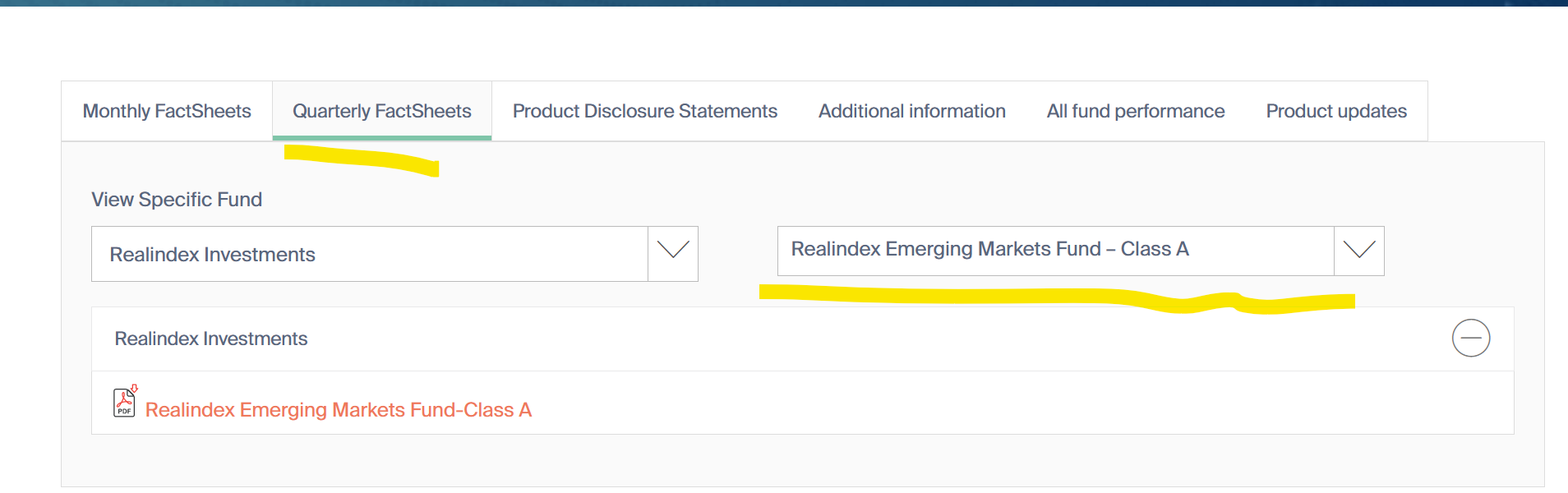
https://www.firstsentierinvestors.com.au/au/en/adviser/performance/literature.html
If March / June / Sept / Dec use Quarterly Tab, otherwise use Monthly
asset_class: Foreign Equity
asset_category: Emerging Markets
peer_benchmark: Foreign Equity - Emerging Markets Index
broad_market_index: World Emerging Markets Index
structure: Managed Fund