September, 2023
We continued to monitor macroeconomic developments as well as the performance of individual companies, amending exposures as relative valuations between individual securities moved.
Investment in banks and selected REITs was increased, for example, with relative valuations appearing attractive in these areas of the market. A thorough analysis of the risk/reward trade-off is required before investing in individual names, but pleasingly favourable security selection in these sectors added value to the portfolio.
We also added to the Fund’s exposure to high-quality residential mortgage backed securities, which offer good value for risk in our view. The addition of these securities should help support the Fund’s overall income generation.
The Fund remains very well diversified, currently holding exposure to well over 400 issues across 28 countries. Maintaining such a high level of diversification mitigates risk, and helps to provide consistent long-term returns
File: https://commentary.quantreports.net/wp-content/uploads/2021/01/Global-Credit-Income-Fund-Adviser-Quarterly-1.pdfJune, 2023
Credit spreads narrowed meaningfully in the June quarter, which supported favourable returns from the asset class. The Fund appreciated by 1.7% during the period, after fees.
Active management of the portfolio – during what was a fairly volatile period for investment markets – helped preserve capital and generate pleasing returns for unit holders. Fund returns were 0.8% above the bank bill benchmark over the quarter and 4.0% ahead in the FY23 year as a whole. These outcomes helped preserve the Fund’s favourable long-term performance track record.
File: https://commentary.quantreports.net/wp-content/uploads/2021/01/Global-Credit-Income-Fund-Adviser-Quarterly.pdfMarch, 2023
The Fund appreciated by 1.3% during the quarter after fees, supported by the receipt of coupon income. Returns were 0.5% ahead of the bank bill benchmark.
The favourable performance was partly due to value-adding active management during a period of volatility in March, in particular.
There was a fair amount of activity in the portfolio as we looked to take advantage of volatile market conditions, particularly during March. During this period we took profits from recent outperformers and reallocated the proceeds of these sales into cyclical names and banks that had struggled more than most during the banking crisis-related sell-off. These moves proved beneficial on the whole, with spreads subsequently retracing some of their earlier widening.
We also monitored the new issuance pipeline for new investment opportunities. The Fund participated in the issuance of new bonds from Regal Rexnord (US; electric componentry) and SK Hynix (South Korea; semiconductors), for example. Both of these deals were attractively valued in our view, with attractive yields that should add to the Fund’s prospective income generation over time.
We will continue to monitor macroeconomic developments as well as the performance of individual companies and remain prepared to amend portfolio positioning as and when required to help preserve capital. For now the Fund remains very well diversified, both geographically and by industry sector. At the end of March, the Fund held exposure to nearly 430 issues, across 26 countries. Maintaining such a high level of diversification mitigates risk, and should help ensure that any unexpected defaults do not have an out-sized influence on returns.
File: https://commentary.quantreports.net/wp-content/uploads/2021/01/Wholesale-Global-Credit-Income-Fund-Adviser-Quarterly-8.pdfDecember, 2022
Corporate bonds performed well in the December quarter, with credit spreads tightening in the investment grade and high yield sub-sectors. The Fund rose in value by 2.7% on a net of fee basis, a return that was comfortably ahead of the bank bill benchmark.
It was pleasing to see favourable performance in the final quarter of the year, following weakness earlier in 2022. Despite the improvement, the Fund was not quite able to claw back all of its earlier losses and returned -0.7% in 2022 as a whole after fees. This compared to a return of 1.3% from the benchmark. That said, the portfolio starts 2023 with a significantly higher yield of 4.84% and an option adjusted spread of 175 bps, versus 1.39% and just under 100 bps at the beginning of 2022. This augurs well for expected performance in the year ahead and supports our confidence of achieving the Fund’s return objectives.
The performance of the Fund was substantially better than comparable products where interest rate risk is unhedged. Returns from some global credit funds were as low as -15% over the year, owing to sharp increases in government bond yields. The performance of the Wholesale Global Credit Income Fund will remain largely unaffected by future movements in government bond yields. This is important to bear in mind, particularly given the possibility of even higher government bond yields if inflation remains elevated and if central banks continue to tighten policy settings.
Individual holdings in the portfolio continued to be actively managed, with various exposures amended in response to evolving risk/return expectations. The Fund no longer has any direct exposure to Chinese issuers, for example, following sales of names including Alibaba Group, Baidu, and Tencent Holdings. The outlook for growth in China remains highly uncertain and we are mindful of potentially deteriorating liquidity in the USD-funding market.
At the same time, investment in Tier 2 securities in Australia was lowered. These notes – typically issued by banks – held up reasonably well despite some regulatory uncertainty. The introduction of new guidelines by APRA during the quarter could have some implications for the Australian subordinated debt market moving forward, so it seemed prudent to reduce exposure to this part of the market.
On the buy side, the Fund participated in the issuance of new bonds from Korean bank Shinhan, as well as Airservices and Australia Post closer to home. All of these securities offered attractive yields given their perceived risk profile.
File: https://commentary.quantreports.net/wp-content/uploads/2021/01/Wholesale-Global-Credit-Income-Fund-Adviser-Quarterly-7.pdfSeptember, 2022
Net of fees, the Fund appreciated by 0.8% over the quarter, which was well ahead of the 0.4% return from the bank bill benchmark. Performance continued to be supported by the regular receipt of coupon income – this more than offset the impact of slightly wider credit spreads over the period.
Returns remain in the red in the calendar year to date, owing to the impact of widening credit spreads. That said, much higher risk-free rates and wider spreads have improved the return outlook. ‘All in’ yields from US investment grade credit have risen above 5%, for example; the highest level for more than a decade. This augurs well for the generation of income in the period ahead, and should help the Fund achieve its performance objectives over the full market cycle.
File: https://commentary.quantreports.net/wp-content/uploads/2021/01/Wholesale-Global-Credit-Income-Fund-Adviser-Quarterly-6.pdfJune, 2022
Widening credit spreads were a headwind for performance and resulted in the Fund declining in value by 3.1% after fees. This compared to a return of 0.1% from the bank bill benchmark.
Effective portfolio management helped limit losses and preserve capital. Whilst returns were behind the bank bill benchmark, the Fund comfortably outperformed traditional credit indices. This was partly thanks to a bought protection position in European credit, which cushioned the impact of widening spreads in the region. Higher-than-usual cash levels were also maintained, which can be deployed in the market in due course.
The Fund remained very well diversified, with exposure to nearly 450 issuers at quarter end. Maintaining a high level of diversification mitigates risk, helping to ensure that unexpected defaults do not have an out-sized influence on returns. As well as having investments in a high number of issuers, the portfolio is well diversified geographically and by industry sector. That said, the portfolio has no direct exposure to areas of the credit market where we believe default risk is highest, e.g. in the Chinese property sector, emerging market bonds, or in the leveraged buy-out space in the US.
The Fund remained cautiously positioned in Europe. Ukraine-related tensions remain unpredictable, energy costs are soaring, and it remains to be seen how economies will respond to interest rates being raised. Valuations are becoming increasingly appealing for long-term investors, but we will wait to see how credit markets in the region respond to the termination of the European Central Bank’s bond buying program before increasing exposure meaningfully.
File: https://commentary.quantreports.net/wp-content/uploads/2021/01/Wholesale-Global-Credit-Income-Fund-Adviser-Quarterly-5.pdfMarch, 2022
Wider credit spreads hampered returns and resulted in the Fund declining in value by 1.1% over the quarter, after fees. This was behind the 0.0% return from the bank bill index. That said, performance was ahead of traditional credit benchmarks as active management and careful portfolio positioning helped preserve capital.
File: https://commentary.quantreports.net/wp-content/uploads/2021/01/Wholesale-Global-Credit-Income-Fund-Adviser-Quarterly-4.pdfDecember, 2021
The identification of a new variant of Covid-19 – named Omicron – adversely affected risk appetite and saw investment grade credit spreads widen over the quarter. This hampered returns from credit markets and resulted in the Fund declining in value by 0.3%. This compared to a return of 0.0% from the bank bill benchmark. In spite of the negative return in the most recent period, the Fund appreciated by 1.3% over the year. This was broadly in line with expectations and consistent with the Fund’s stated performance objectives. For context, the bank bill benchmark returned 0.0% over the year
File: https://commentary.quantreports.net/wp-content/uploads/2021/01/Wholesale-Global-Credit-Income-Fund-Adviser-Quarterly-3.pdfJune, 2021
Corporate bonds were buoyed by generally favourable sentiment towards equities and other risk assets. The bellwether S&P 500 Index in the US rose in all three of April, May and June, for example. The Fund appreciated against this background, adding 0.8%. This extended the Fund’s return in the FY21 year as a whole to 5.4%, net of fees – a pleasing return given the bank bill benchmark returned just 0.1% over the year.
Given our cautiously optimistic outlook for the asset class, we were comfortable increasing the overall risk profile of the portfolio modestly. Exposure to a broad range of companies was increased, including Oracle in the US, Naver in Asia, and Victoria Power Networks in Australia. Investment in BP and ENI was also increased. Sentiment towards energy companies has been supported recently by a sharp increase in oil prices. The Fund also participated in the new issuance of a US$500 million sustainability-linked bond from Australian engineering firm Worley. As part of the process, Worley has committed to significantly reduce its carbon footprint. As responsible investors we support initiatives like these, and were very comfortable adding the bonds to the portfolio.
File: https://commentary.quantreports.net/wp-content/uploads/2021/01/Wholesale-Global-Credit-Income-Fund-Adviser-Quarterly-2.pdfMarch, 2021
Given our cautiously optimistic outlook for the asset class, we were comfortable increasing the Fund’s credit risk profile. At the same time, we continued to monitor evolving valuations of all investments in the portfolio, and took profits in some that have performed well recently. In some cases, we are also able to exploit valuation differentials between securities issued by the same company. Towards the end of the quarter, for example, we switched exposure from various companies’ EUR-denominated issues into USD-denominated equivalents, where relative valuations had diverged. Exposures remain well spread, both geographically and by industry sector. At the end of March, the Fund held exposure to more than 330 companies, across 27 different countries. Maintaining such a high level of diversification helps mitigate investment risk, and should help ensure unexpected defaults do not have an out-sized influence on performance outcomes.
File: https://commentary.quantreports.net/wp-content/uploads/2021/01/Wholesale-Global-Credit-Income-Fund-Adviser-Quarterly-1.pdfDecember, 2020
Despite some fluctuations as confidence ebbed and flowed, credit spreads narrowed over the quarter. This assisted performance and helped the Fund appreciate by 2.2%. This was well ahead of a return of 0.0% from the bank bill benchmark.
Investment Grade spreads narrowed by 36 bps, to 1.00%, while High Yield spreads closed the quarter 134 bps lower, at 3.29%. Encouragingly, credit spreads are back to where they were a year ago. Ultimately, despite an uncomfortable pickup in volatility over the past 12 months, global credit has generated favourable returns for investors that persevered with the asset class during and after the Covid shock.
There was a fair amount of activity among individual positions, reflecting evolving relative valuations of securities. Credit spreads have moved a long way in a relatively short period of time, and not uniformly across different areas of the market. This underlines the need for diligence and ongoing active management of the portfolio. We reduced the Fund’s investment in some names that have performed particularly well recently. Exposure to Bunge, ISSDC, Unibail and Ventas Realty was lowered, for example.
Irrespective of the prevailing market backdrop, we believe it is always prudent to maintain a high level of diversification in the portfolio. Exposures remain well spread, both geographically and by industry sector. Ultimately, a high level of diversification should help ensure any unexpected defaults do not have an out-sized influence on overall performance, and therefore mitigates investment risk. With that in mind, at the beginning of the new year the Fund was invested in over 300 issues, spread across 25 countries.
File: https://commentary.quantreports.net/wp-content/uploads/2021/01/Wholesale-Global-Credit-Income-Fund-Adviser-Quarterly.pdfticker: FSF0084AU
release_schedule: Quarterly
commentary_block: Array
factsheet_url:
https://www.firstsentierinvestors.com.au/au/en/adviser/performance/literature.html
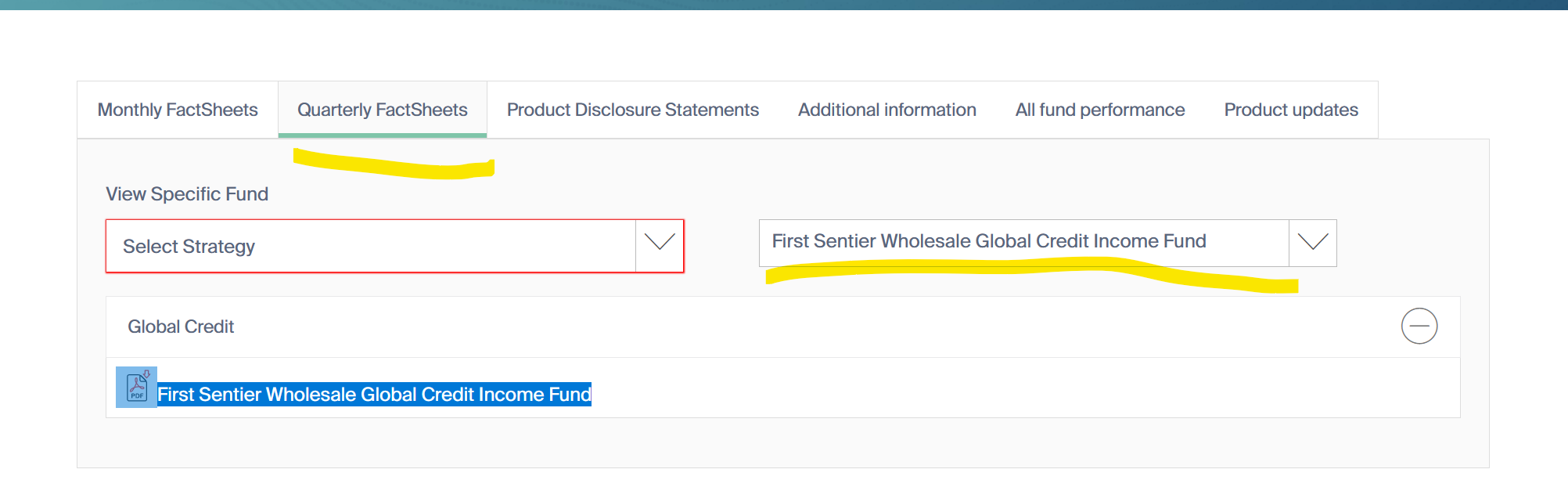
See graphic, then Fund Performance + Fund Activity section
fund_features:
The First Sentier Global Credit Income Fund invests in a diversified portfolio of higher yielding Australian and international fixed interest investments. The fund invests in a portfolio of predominantly global credit securities aiming to earn an income return from its investments, controlling risk through careful selection and monitoring, combined with broad diversification.
- The objective is to provide income-based returns and to outperform the Bloomberg AusBond Bank Bill Index over rolling three-year periods before fees and taxes by investing in a diversified portfolio of relatively higher yielding Australian and international fixed interest investments.
- The increased credit risk of credit securities means that these investments have the potential to deliver higher returns over the medium term compared to cash.
- Derivatives may be used for risk management or return enhancement.
- The fund aims to hedge currency exposure.
manager_contact_details: Array
asset_class: Fixed Income
asset_category: Diversified Credit
peer_benchmark: Fixed Income - Diversified Credit Index
broad_market_index: Global Aggregate Hdg Index
structure: Managed Fund